
(Warning: This blog post is non-technical but purely personal. In my leukemia diary, I write openly about my current health issues. This blog might be triggering for people who struggle with, or lost dear ones to, cancer and other similar diseases.)
My last leukemia diary entry ended with a large question mark. What will my hematologist tell me when I see her again? What treatment will she recommend?
What happened? No idea!
Do you know this scenario? A new prospect calls. You have never seen their database system yet. But they do expect you to give a coherent and relevant answer to their burning question: “why is our database suddenly slower than normal?”
You are confident that you will find the real answer once they hire you and give you access. But you first need to score that contract, so you need to give an answer that convinces them that you know your stuff, and they can safely hire you. So you use your generic knowledge of databases, and specifically of SQL Server, to come up with an answer that sounds convincing and might even be close to the truth – even though in reality, you have no idea why their database is slow. You’re just guessing.
I’ve heard that tone of voice a few times, the last weeks. First when the Amsterdam hematologist called me with the news that my blast cells had gone down from 9% to 3.8%, more than four weeks after the end of my chemotherapy, and I asked him what might have caused that. He gave me a reply that sounded convincing. But his tone of voice included doubts. And then, today, I asked my regular hematologist the same question. Her answer also sounded convincing, although it was very different from what her colleague had told me. And her voice had the same shade of doubt.
The bottom line is this. Chemotherapy is a slow working poison. It wrecks your body, but also (hopefully) your cancer cells, during roughly the two-week period after the last dosage. That’s when you reach what is called “the dip”: the lowest point, with the worst blood values. After this, your body begins to rebuild and you’ll gradually start to feel better.
By that time, all the poison that was infused during chemotherapy has left the body again. So the normal expectation is that not only the healthy parts of the body will start to grow back, but also the cancer cells. That’s why the bone marrow puncture is taken four weeks after the chemotherapy, when its effect is maximal. After that, the cancer will start to regain ground.
Except in my body, it didn’t. A blast percentage of 9% at that four week mark. But then 3.8% three weeks after that. And the hematologists cannot explain what might have caused this. My regular hematologist even told me that, between her and four colleagues, fifty years of combined experience, they had only seen one other case where blasts reduced after the four-week bone marrow puncture. And that case was not comparable to mine in other ways.
But the bottom line is this. The blast cells in my bone marrow have clearly gone down. That is an indication that the cancer has been battled down, at least a bit. This happened between four and seven weeks after the end of the chemotherapy, so clearly not as a result of those chemicals. It must be something inside me. Something my body does, or has done, that has this effect. Even the hematologists do not know how or why, so I won’t even try to guess.
Further treatment
With a blast percentage below 5%, I now once more qualify for the regular treatment. The stem cell donor that had already been selected for me back in March had been called off after the first bone marrow puncture showed too many blast cells. The hospital reached out to them again, but they have vacation plans, and this would delay the procedure too much.
So my hematologist instead chose to accept a smaller delay, by moving on to the next potential donor on the list. This person needs to be contacted, and then there will be lots of examinations to make sure they qualify. Which means that the earliest possible start of my next chemotherapy, which will then lead into the stem cell transfusion, would be in the second half of June.
Between May 11 and half June is a long time. My hematologist does not want to give my cancer cells any chance to regrow, now that they are finally below the 5% mark. So she prescribed a “maintenance chemotherapy” treatment for me. That is similar to normal chemotherapy, but at a lower dosage. Which means that the side effects will likely be less severe as well.
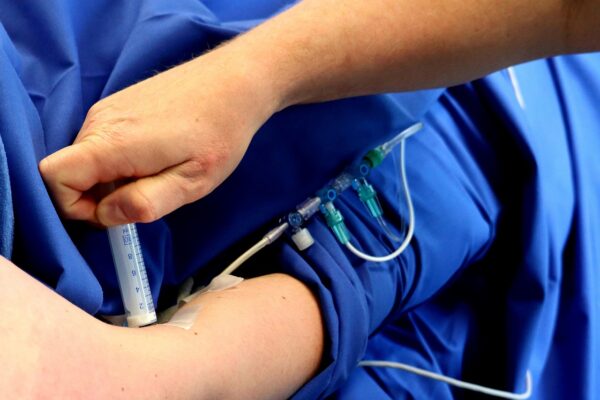
This means four days in hospital, because the chemotherapy has to be administered through an IV drip, two times three hours per day. But after that, I can go back home again. Even though the dip will only come after that, I can go home once the last chemo is in my body. Through three outpatient visits per week for the next two weeks, the hospital can monitor my health sufficiently. The lower dosage of chemicals means that constant observation in the hospital is not needed in this case. I will only be kept in hospital if, during this period, unexpected complications occur.
The hospital stay is already in my past. I was admitted May 13, and discharged on May 16. My first outpatient visit was yesterday, and all was good. My next one is tomorrow.
I feel good at this time. My energy is a bit lower than it was before I went to the hospital. But that makes sense. After all, those nasty chemicals the doctors put into my body are supposed to have a damaging effect on my blood. But I still do have energy for my daily walks (just a bit shorter now), and I can also do all kinds of other things during the day.
Will that change? Likely. I’m not fully in the dip yet. That will take a few more days. And while the dip will be relatively shallow this time, due to the lower dosage of chemo, it will be there and I expect to notice it. But for now, life looks good.
After this
I still have five outpatient visits scheduled for the next two weeks. And then, two weeks after that, yet another bone marrow puncture. This will be a key moment again. What will the blast percentage be this time? Will it have remained stable? Gone further down? Or gone up again?
A lot depends on that measurement. For now, the plan is clearly to return to what was the original plan already when my leukemia was found to be back: a second round of chemotherapy (high dosage, this time), instantly followed by an infusion of donor stem cells. And after that, all we can do is cross our fingers and hope it all works out.
What if, in four weeks, we see another disappointing blast percentage? One thing is certain: I will instantly schedule another test two or three weeks later, to see if my body is able to repeat the unexplained trick it pulled before.
But for the rest? Will we continue with the stem cell transfusion, even if the next bone marrow puncture once more comes back with disappointing results? I really do not know. That is a question I will ask my hematologist if and when the situation arises. So let’s hope that I never have to ask, and never have to find out.






2 Comments. Leave new
Hugo,
Best of luck to your comeback and stomping out leukemia this time. All you can do is your best. A good start is half the work. Keep the hope strong and be determined to win.
Just sending you big hugs – keep doing what you’re doing 💜